Self-Healing Solar Cells: Why This Might Be the Last Solar Panel You’ll Ever Need?

Solar panels are engineered to last about 30 years, enduring decades of harsh weather and constant sunlight. But what if we could push that lifespan even further—potentially forever?
Imagine solar panels that can repair themselves, maintaining peak efficiency throughout their entire lifetime. This revolutionary idea is at the heart of a new generation of perovskite solar cells with self-healing capabilities. These innovations promise to reshape the solar industry, provided they can transition from the laboratory to the real world.
Why Do We Need Self-Healing Solar Panels?
Solar panels are remarkable technology, but even they are not immune to wear and tear. While they capture sunlight to generate power, the very sun that fuels them also takes a toll on them.
Over time, exposure to UV rays, heat, humidity, hail, snow, dust, and temperature fluctuations gradually degrade their efficiency.
On average, solar panels lose about 0.5% to 0.8% of their efficiency each year. This decline affects not just their lifespan but also their ability to deliver consistent, high performance.
When a single solar cell within a panel fails, replacing it is often impractical, especially in complex installations like satellites or space probes, where maintenance missions are costly or impossible.
Moreover, the very durability that helps panels endure decades also complicates recycling efforts, increasing environmental impact. Extending the functional life of solar panels through self-repair could reduce waste and improve the return on investment for solar energy systems.
The Origins of Self-Healing Solar Technology
The concept of self-healing solar cells dates back to 2010 when Professor Michael Strano from MIT drew inspiration from nature. Plants continuously repair their photosynthetic machinery, replacing damaged molecules within hours to maintain energy production despite exposure to harsh sunlight.
Strano’s team mimicked this dynamic process by creating “dynamic cells” using carbon nanotube scaffolds combined with light-sensitive proteins called phospholipids. Although the amount of electricity generated was minimal, this proof of concept opened the door for future breakthroughs.
More recently, researchers at York University discovered that antimony selenide, a solar-absorbing material, can self-heal damage, much like salamanders regrowing their limbs. The material repairs broken chemical bonds on its own, demonstrating a natural self-healing mechanism that could be harnessed for solar technologies.
HUBLA: The Self-Healing Compound Transforming Perovskite Solar Cells
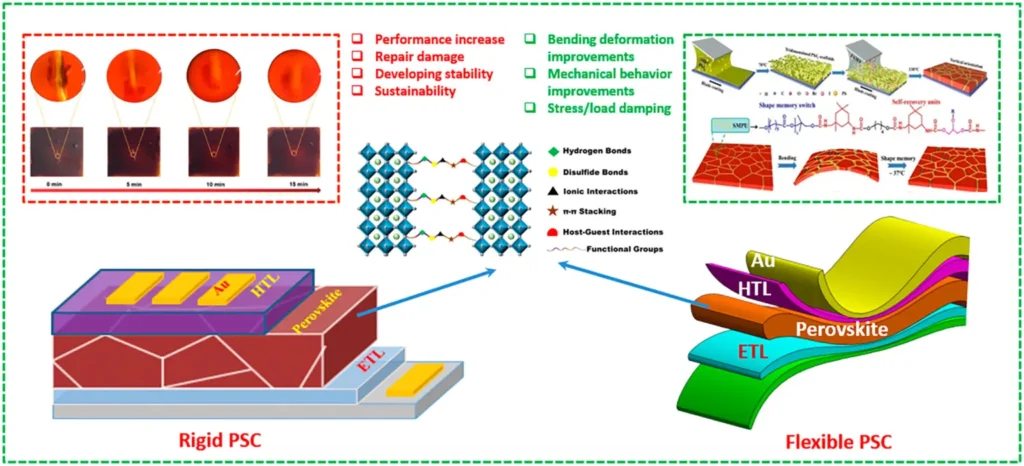
One of the most exciting advancements comes from teams at Monash University, Oxford, and City University of Hong Kong, who developed a compound called HUBLA—short for Hydrogen-bonded Urea-Based Ligand Addition. This compound acts as a “living passivator” that repairs defects in perovskite solar cells when exposed to stressors like heat and humidity—ironically, the very factors that usually cause damage.