
Future of Floating Solar Power Plants in India

We all know how fast India is growing—and along with that, our electricity demand is also rising. India is working hard to achieve net-zero emissions by 2070 to meet our climate goals and ensure a sustainable future. Solar energy is expected to play the biggest role in this mission.
Right now, India has installed nearly 102.57 GW of solar capacity, and the majority of solar installation contribution comes from groundmount-based solar power plants. We will need around 5630 GW of solar power to reach our net-zero target.
Sounds like a huge number, right? But here’s the bigger challenge—1 GW of solar power plant requires around 4–5 square kilometers of land. That means for 5630 GW, we would need roughly 22,520 to 28,150 square kilometers of land. To put it in perspective, that’s almost equal to the size of states like Meghalaya or Punjab.
This is a serious concern in a country like India, where land is already limited and the population is dense. That’s why Floating Solar Power Plants or FSPV (Floating Solar Photovoltaic) are gaining attention.
What is a Floating Solar Power Plant?
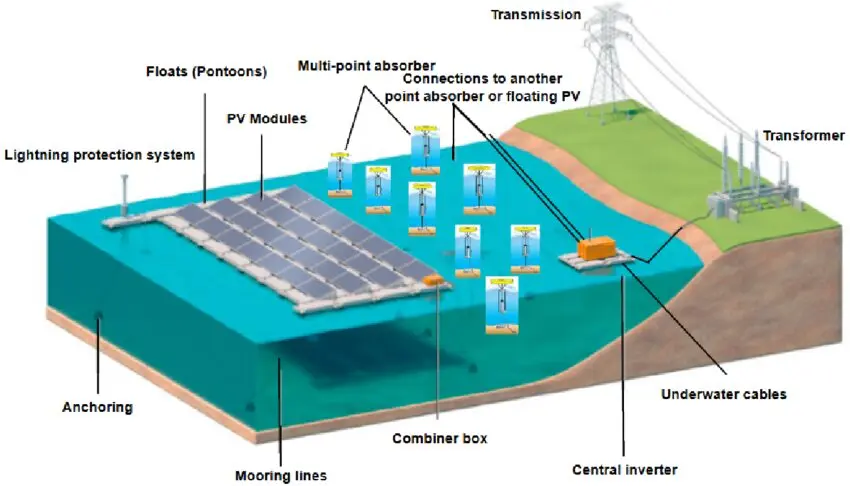
A Floating Solar Power Plant, or FSPV, is precisely what it sounds like. Instead of installing solar panels on land, the panels are mounted on floating structures and placed over water bodies like lakes, reservoirs, or dams. The entire system floats on the water’s surface while generating clean energy.
Why is FSPV a Good Option for India?
Several benefits make floating solar a smart choice:
- Saves Land: India already faces land scarcity. Floating solar panels allow us to generate clean energy without using valuable land—perfect for a densely populated country.
- Better Performance: Solar panels installed on the water stay naturally cooler, which helps improve their efficiency by 5–10% compared to ground-mounted systems.
- Reduces Water Evaporation: In reservoirs and dams, floating panels block direct sunlight and reduce water evaporation, which is very useful in areas with water shortages.
- Utilizes Unused Water Bodies: Many man-made reservoirs, lakes, and dam surfaces in India are underutilized. Floating solar makes productive use of these water surfaces.
What are the Challenges?
While the idea sounds perfect, there are some challenges too:
- Higher Cost: FSPV systems are currently more expensive than ground-mounted systems because of floating structures and anchoring.
- Technical Expertise: Designing and maintaining floating plants requires specialized knowledge.
- Environmental Concerns: The impact on aquatic ecosystems and water quality needs to be studied carefully.
- Grid Connection: Many reservoirs or remote water bodies are far from grid connectivity.
Also read: Climate Change: A Reality We Can No Longer Ignore