
On-Grid vs Off-Grid Solar: Which System Is Right for You?

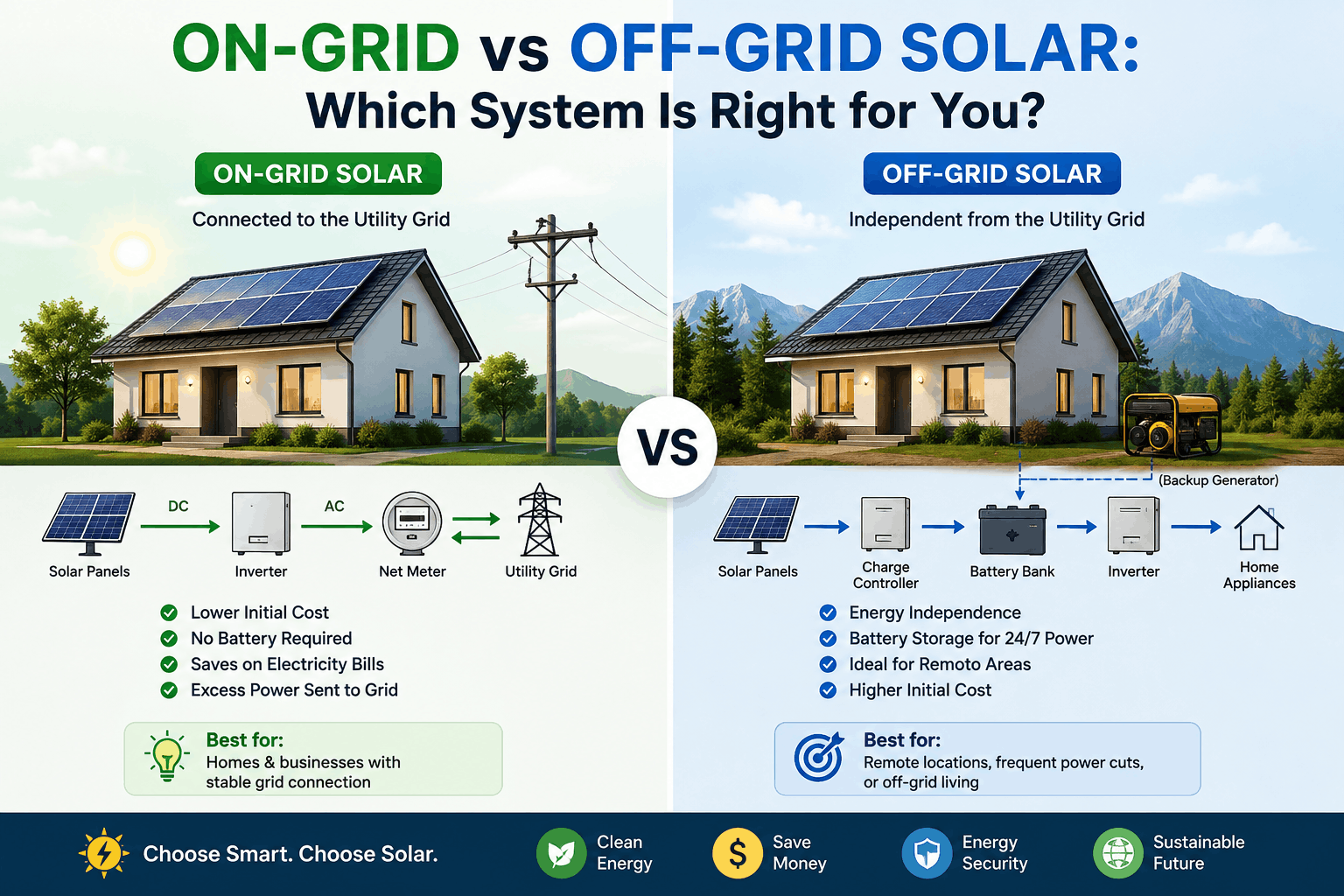
Solar power can slash your electricity bill and make your home more resilient but the best system depends on whether you stay connected to the utility grid or go completely independent. In short, on‑grid solar is tied to the grid and uses net metering to offset your bill, while off‑grid solar runs standalone with batteries (and often a generator) so you don’t rely on the utility at all.
What is on‑grid solar?
An on‑grid (grid‑tied) solar system is connected directly to your local electricity grid. It generates power from solar panels, converts it to AC via an inverter, and uses that power first to run your home or business. Any surplus is exported to the grid, and when solar isn’t enough (night, cloudy days), you draw from the grid.
How it works, step by step
- Solar panels capture sunlight and produce DC electricity.
- A grid‑tie inverter converts DC to AC that matches the grid’s voltage and frequency.
- Your home uses solar power first, reducing what you buy from the utility.
- Excess energy is sent to the grid and recorded via a net meter.
- At night or during low production, you import from the grid as usual.
Key features
- No batteries required (though you can add them later for backup).
- Net metering credits you for exported energy, often leading to near‑zero bills in sunny months.
- Lower upfront cost than off‑grid because you avoid large battery banks.
- Shuts down during grid outages unless you have a hybrid/battery system with islanding.
What is off‑grid solar?
An off‑grid (standalone) solar system is not connected to the utility at all. It must generate, store, and manage all your electricity on site—typically with a sizable battery bank, a charge controller, an inverter, and sometimes a backup generator for long cloudy periods.
How it works, step by step
- Solar panels generate DC power from sunlight.
- A charge controller regulates charging to protect batteries.
- Batteries store energy for use at night or when it’s cloudy.
- An inverter converts stored DC to AC for your appliances.
- You consume from batteries/solar; if you run out, loads go dark unless a generator kicks in.
Key features
- Complete energy independence from the utility.
- Mandatory battery storage (and often a generator) to cover nights and bad weather.
- Higher upfront cost and more complex sizing to avoid running out of power.
- Always available power (if sized correctly), even during grid outages because there is no grid connection.
On‑grid vs off‑grid: Quick comparison
| Feature | On‑Grid Solar | Off‑Grid Solar |
|---|---|---|
| Grid connection | Required | Not connected |
| Battery storage | Optional (often none) | Required |
| Power during outages | No (unless hybrid/battery added) | Yes, by design |
| Upfront cost | Lower | Higher |
| Ongoing bills | Reduced via net metering | No utility bill; you cover all generation/storage |
| Best for | Reliable grid; bill reduction | Remote sites, unreliable/no grid, full independence |
| Complexity | Simpler | More complex sizing and maintenance |
Costs and payback (at a glance)
- On‑grid systems are usually the most affordable way to cut bills because they don’t need large batteries. In many regions, payback can be within a few years thanks to net metering and subsidies.
- Off‑grid systems can cost several times more for the same capacity due to batteries, charge controllers, and possible generators. They’re priced for resilience and independence, not just bill savings.
Pros and cons
On‑grid solar
Pros
- Lower cost and simpler installation.
- Net metering can dramatically reduce or eliminate monthly bills.
- Easy to scale up later; compatible with most roofs.
Cons
- No backup during grid outages unless you add batteries/hybrid inverter.
- You still depend on grid availability and policies (net metering rules can change).
Off‑grid solar
Pros
- Full energy independence; works even if the grid fails or doesn’t exist.
- Ideal for remote homes, farms, cabins, and areas with frequent/long outages.
Cons
- Much higher upfront cost and ongoing maintenance (especially batteries).
- Requires careful energy management; you can run out of power if undersized.
Which is right for you? A simple checklist
Choose on‑grid if:
- You have a reliable grid and mainly want to reduce your electricity bill.
- You don’t need guaranteed power during outages (or you’ll add a small battery later).
- You want the lowest cost per kW and simplest setup.
Choose off‑grid if:
- You have no grid connection or very unreliable supply.
- You prioritize complete energy independence and are ready to invest in storage.
- You can commit to proper system sizing and occasional generator use in long low‑sun periods.
FAQs
Can I switch from on‑grid to off‑grid later?
Technically yes, but it usually means redesigning the system and adding significant battery capacity and controls often more expensive than planning for it upfront.
Do on‑grid systems work during power cuts?
Standard on‑grid inverters shut down during outages for safety. You need a hybrid inverter or battery backup with islanding to keep critical loads running.
Is net metering available everywhere?
No. Net metering policies vary by region and utility. Check local rules before you size your system.
How much battery do I need for off‑grid?
It depends on your daily usage and how many cloudy days you want to cover. A common approach is to size for 1–3 days of autonomy, then add a generator for longer stretches.
Final takeaway
If your goal is lower bills with minimal hassle and you have a stable grid, on‑grid solar is usually the smartest first step. If you need power no matter what or live where the grid is absent or unreliable, off‑grid solar (or a well‑designed hybrid) is the better path.
Want help sizing a system or comparing on‑grid vs hybrid options for your home? Share your average monthly bill and location, and I can outline a tailored setup.